

What large estates can learn from NHS decarbonisation challenges
Decarbonising large, complex estates is no longer a question of isolated projects, it requires a shift toward strategic energy infrastructure planning.
Few environments illustrate this challenge more clearly than the UK’s healthcare estate.
While the context is public sector, the lessons are directly relevant to commercial and industrial organisations managing large, energy-intensive portfolios.
The Challenge of Complex Estates
Large estates – whether hospitals, logistics hubs, or manufacturing sites – share a common set of challenges:
- High, continuous energy demand
- Operational environments that cannot tolerate disruption
- Ageing or complex infrastructure
- Fragmented development over time
- Competing capital priorities
In healthcare, these challenges are amplified by 24/7 operations and critical systems. But the underlying issue is universal:
Energy demand cannot simply be reduced, it must also be decarbonised.
Progress Has Been Real – But Limited
Across many large estates, early decarbonisation efforts have focused on:
- Lighting upgrades
- Building management improvements
- Equipment efficiency
- Small-scale solar installations
These interventions are valuable, and necessary.
But they tend to:
- Focus on individual buildings
- Sit within existing capital budgets
- Avoid complex delivery models
As a result, they deliver incremental improvements, rather than transforming how energy is generated and used.
The Shift: Energy as Strategic Infrastructure
In the private sector, a different approach is emerging.
Energy-intensive organisations, across logistics, manufacturing, and food production,are increasingly:
- Generating electricity on-site
- Locking in long-term energy pricing
- Treating energy as a strategic asset, not just a cost
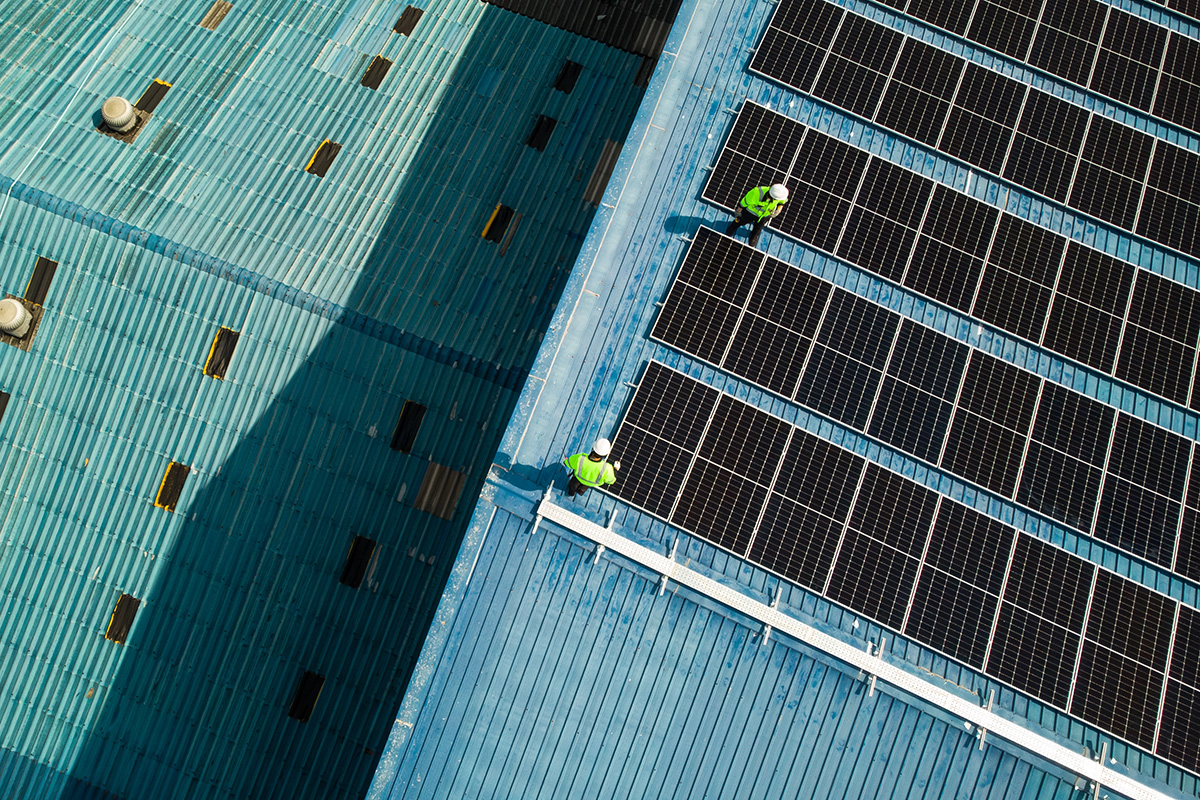
A practical example is Iceland Foods’ distribution network, where rooftop solar is now generating millions of kWh annually, reducing both carbon and cost exposure.
The key shift isn’t just technological.
It’s how energy is positioned within the business.
Solar + Storage: Practical and Scalable
Solar PV remains one of the most viable technologies for large estates:
- Proven and widely deployed
- Predictable generation profiles
- Minimal disruption during installation
- Low ongoing maintenance
When combined with battery storage, it becomes even more effective, enabling:
- Greater use of on-site generation
- Reduced peak demand
- Improved resilience during grid disruption
For estates with strong daytime demand, this alignment is particularly powerful.
Why Rooftops Alone Aren’t Enough
Rooftop solar is often the starting point, but rarely the full solution.
Across complex estates, constraints can include:
- Limited available roof space
- Structural or plant restrictions
- Competing operational uses
Which raises a critical point:
Meeting net zero targets requires more than rooftop optimisation.
Unlocking Additional Capacity
To scale renewable generation, estates must look beyond rooftops.
Car park solar canopies
An underutilised opportunity across many estates, offering:
- Significant additional generation capacity
- No competition with rooftop infrastructure
- Integration with EV charging
- Visible sustainability impact
Ground-mounted solar
Where land is available, this can provide:
- Larger system capacity
- Lower installation costs
- Greater flexibility in design and maintenance
Private-wire solutions
In some cases, renewable generation can be delivered near-site and supplied directly, bypassing constraints altogether.
The Real Barrier: Capital
For many organisations, the biggest constraint isn’t space or technology, it’s funding.
Large estates face competing priorities:
- Core operations and growth investment
- Asset maintenance and upgrades
- Digital and infrastructure programmes
Energy projects often struggle to compete.
A Different Approach to Delivery
This is where financing models become critical.
Across commercial sectors, organisations are increasingly adopting Power Purchase Agreements (PPAs).
Under this model:
- A developer funds and installs the system
- The system is operated and maintained externally
- The business purchases the electricity generated
This enables:
- No upfront capital investment
- Predictable, long-term energy pricing
- Transfer of operational and performance risk
Through partnerships, such as Ortus Energy and SSE Energy Solutions, this model is being deployed at scale across commercial estates.
From Projects to Strategy
The core takeaway is simple:
Decarbonisation at scale requires moving beyond projects to programmes.
That means:
- Combining multiple technologies (solar, storage, canopies, ground-mount)
- Deploying across entire estates, not individual buildings
- Structuring delivery around long-term financial and operational outcomes
A Defining Opportunity
Large estates represent one of the UK’s most significant untapped opportunities for renewable energy generation.
The organisations that succeed will be those that:
- Treat energy as a strategic priority
- Unlock the full potential of their assets
- Adopt delivery models that enable scale
Explore What This Means for Your Estate
If you’re assessing how to decarbonise a large commercial or industrial portfolio, the structure of your approach matters as much as the technology.
Download our guide: Capex vs PPA to understand how different funding models impact cost, risk, and long-term value.