
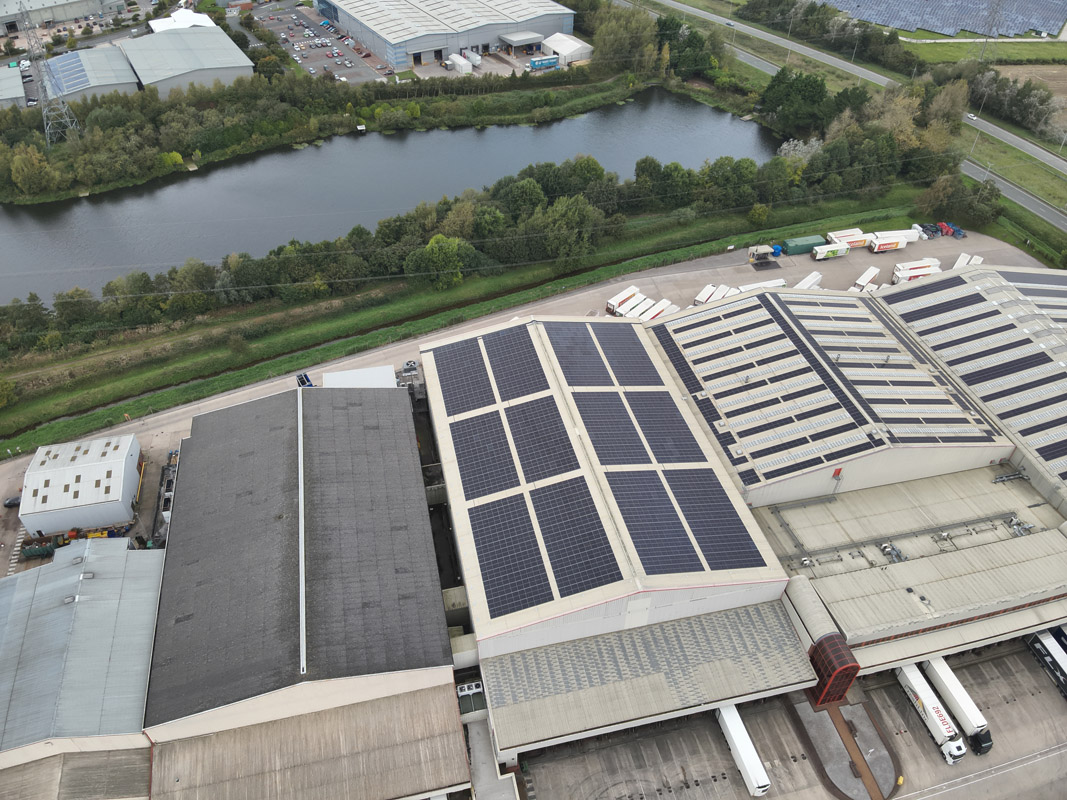
Iceland Foods has reached a significant milestone in its transition to net zero electricity, completing the first phase of a large-scale rooftop solar programme across its UK distribution network.
Delivered in partnership with Ortus Energy and SSE Energy Solutions, the initiative demonstrates how energy-intensive businesses can reduce costs, improve resilience, and accelerate decarbonisation—without upfront capital investment.
From Roof Space to Renewable Power
The programme spans six key distribution centres—Livingston, Enfield, Swindon 1, Swindon 2, Warrington, and Deeside—forming part of one of the most ambitious rooftop solar Power Purchase Agreements (PPAs) in the UK food logistics sector.
The first phase, now operational at Swindon 1 and Deeside, is already delivering measurable impact:
- 3.086 MW of generating capacity across both sites
- 2.7 million kWh of clean electricity generated annually
- 550 tonnes of CO₂ reduced in the first year
That level of generation is equivalent to powering an average Iceland store for over five and a half years.
Efficiency at Scale
While not the largest rooftop solar installation in the UK by footprint, the project stands out for its efficiency—delivering high generating capacity from a relatively compact rooftop area.
This reflects the strong alignment between food logistics infrastructure and on-site solar generation. Large, consistent energy demand combined with extensive roof space creates an ideal environment for high-performing systems.
A Fully Funded Model for Commercial Energy Users
The project is delivered through Ortus Energy’s fully funded Solar PPA, in strategic partnership with SSE Energy Solutions.
Under this model:
- Ortus develops, installs, and operates the solar infrastructure
- SSE Energy Solutions provides funding and energy expertise
- Iceland purchases the electricity generated at a stable, long-term price
This structure removes the need for upfront capital investment, while providing long-term cost certainty and reducing exposure to volatile energy markets.
The agreement spans 25 years, enabling Iceland to embed renewable energy directly into its operational strategy.
Unlocking Value Across the Warehouse Sector
According to the UK Warehousing Association, warehouse rooftops across Britain could generate up to 15 GW of solar capacity if fully utilised.
Projects like Iceland’s highlight the scale of this opportunity—and the role the logistics sector can play in accelerating the UK’s transition to net zero.
As Ortus Energy CEO Alistair Booth explains:
“The UK warehousing sector offers a clear pathway to accelerate decarbonisation through rooftop solar. This project with Iceland shows how major energy users can capture long-term value from their real estate by generating clean electricity on-site.”
Designed for Energy-Intensive Operations
For businesses operating large distribution or manufacturing sites, the benefits extend beyond sustainability:
- Lower and more predictable electricity costs
- Reduced reliance on grid supply
- Improved energy resilience
- Increased asset value through infrastructure enhancement
Neil Davidson, Chair of Ortus Energy, adds:
“Food warehousing is uniquely positioned to benefit from rooftop solar. It reduces costs, lowers environmental impact, and makes use of existing infrastructure without additional land requirements.”
A Scalable Model for Net Zero
The Iceland programme forms part of a wider pipeline of commercial rooftop solar projects being delivered by Ortus Energy and SSE Energy Solutions.
With over 130MW of capacity planned across the next two years, the partnership is focused on helping British industry transition to on-site renewable energy at scale.
As Jon Kirby notes:
“Rooftop space across the commercial and industrial sector offers a viable path to deliver low-carbon electricity at scale, while helping businesses meet their decarbonisation goals.”
From Ambition to Operational Reality
Iceland’s approach demonstrates a broader shift in how energy-intensive organisations are approaching net zero.
Rather than relying solely on procurement or offsets, businesses are increasingly:
- Generating energy on-site
- Locking in long-term pricing
- Turning existing assets into energy infrastructure
For organisations with large estates and high energy demand, the opportunity is clear.
Explore What’s Possible
If your organisation operates a large commercial or industrial site, you may already have the infrastructure needed to generate clean energy.
Assess your site potential or download our Capex vs PPA guide to understand how a fully funded solar solution could work for your business.